animal

Tips for Chinchilla Playtime!

As all chinchilla owners know, chins are high energy and high maintenance – there’s no sugar-coating it! We go out of our way to provide safe multi-level havens for our babies, order them the finest foods, and hope that one day they’ll come around and show us some love back! A major part of chinchilla health and bonding is playtime. Playtime is critical for chins, as it gives them a chance to discover a new environment, stretch their legs, and get to know their owners a little better.

Get to know your fluffball. Playtime is an incredible way to get to know your little babies. Chinchillas have abundant personalities, and you miss a lot of that while they’re in their cages. Letting them out will encourage them to approach you (as so oftentimes it’s the other way around) and share their squeaks, leaps, wall jumps, and more with you! I encourage all owners to be very aware of their chinchilla’s behaviors – study them: their idiosyncrasies, movements, and physical characteristics. Any change in personality or behavior can be indicative of a health issue and should be carefully monitored – but you need to know your chinchilla’s baseline personality in order to detect any semblance of a change. There are a lot of health issues or injuries that can be fixed simply by detecting them early, and to put it simply, you can’t catch it if you aren’t looking.

Be present at playtime. Watch them like a hawk! – at least, keep a very watchful eye when you first start letting your chinchillas out. As you get to know your chins, you’ll be able to know which ones respect authority more than others, which ones you can trust around the furniture, and where they like to hide. There’s nothing more terrifying than fearing your chinchilla has dissipated into thin air when they’re actually snoozing under the couch – true story.

Set your boundaries. Many people like nice things, chinchilla owners being no exception (in fact, I think we have the best taste). So, it’s natural to be apprehensive letting your chinchilla out with such lovely molding, fabrics, and wooden furniture strewn about – chins are known for filing their teeth on wooden toys, and they don’t care whether that toy is your bed frame or an appropriately sized apple stick. It’s critical to set your boundaries and take up a stern talking with your chin. The easiest place to start for most homes is the bathroom or closet, as it’s a confined space and easier to spot a misbehaving chin. When you feel comfortable moving into a larger space, start in the new space by keep the playtimes short and working your way up. Trust is something that is built over time, chinchilla-human relations being no exception.

Chin-proof the playroom. The method I use for training my chinchillas not to bite my things starts with me. As people, we are responsible for our furniture, rug, walls, and important documents. No one can protect these things better than ourselves. Oft, it’s as simple as moving something important out of reach or closing the drawers. Chinchillas are so curious – you really can’t blame small animal instinct for why your favorite book (or camera, or passport, etc.) got destroyed. If you can see it, they can probably get to it. There is always a way. So put the birth certificates away, remove the climbing mechanisms, tape cardboard against your molding (make sure the tape is not reachable), shove pillows and blankets under your couches and around your radiators, and close those windows. When you’re done, you’re probably still not done. Those little buggers are more compact than your foresight will lead you to believe, and aren’t scared of venturing where no chin has gone before. It’s best to simply be there and catch them before they do the deed.

I know many owners have playpens, and I’m all for that – but if you have the time and energy to expend on chin-proofing, you’ll find it’s a much more interesting experience, allowing them to be more fully integrated into your space, if only for a moment.
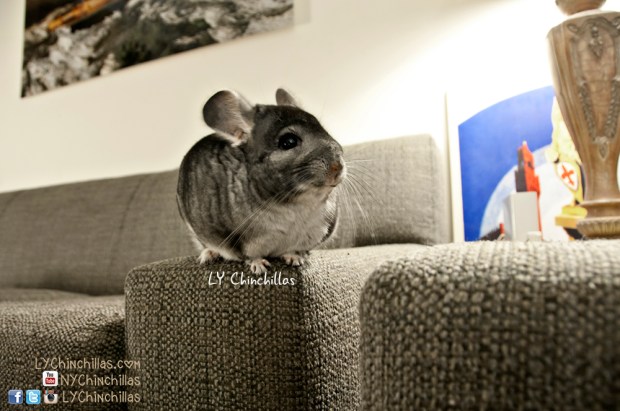
Train. I don’t use treats when I train, I simply use the concept of ‘playtime’ vs. ‘home’. If they want to be out, they have to be good. If I see someone lingering by a wall for too long, I’ll say his/her name in the same manner I’d speak to a disorderly 4-year-old or a misbehaving dog – I’ll utilize the don’t you dare tone. They will hear you, and if they know you well enough, they’ll turn to you and be aware that you are talking to them. Sometimes they’ll stare right at you as they decide their playtime fate, chomping into a picture frame or art piece. Then, they’re headed home to think about what they’ve done. Less intellectual chins may never put it together, wondering with the same fascination each and every time why they’re going back to their cage! However, most chins will begin to see a trend in playtime consequences and learn what they can and can’t bite. I leave chew toys out for them, and allow them to bite on certain furniture such as my barn wood table and wicker chair. Everything else will simply buy them cage time. Again, you must be present in order to train. You can’t be sending mixed messages while they’re out (i.e. when you’re lazing they can bite, when you’re training they can’t), as it defeats the consistency required to teach & learn. If my chins are good, they can be out for up to 45 minutes before they decide they want to fall asleep, tap on the door to go home, or need a sip of water. I’ve found that some of my chins are now able to communicate their needs to me, which is extremely rewarding to recognize.


Enjoy and take your time. My chins are my children. I love spending time with them! They are badass kids at times and don’t care at all for what I have to say. That’s fine, they’ll learn – and, don’t tell them, but if they don’t, I’ll still love them. And watch out for them, and take care of them, and make sure they are safe and healthy. When playtime is over, be sure to collect your chinchilla carefully! Do not rush that final process, and if your pet escapes your clutches, do not panic. Be patient and coax your kids back into your arms or their cage, as long as it takes. I have heard too many horror stories of owners losing their chinchillas by stepping on their beloved pet accidentally, or falling on them when chasing an escaped chin. With all your might, try your best to avoid thoughtless and tragic accidents. Safety first! My best advice is to just take your time – don’t force it, and be genuine. If you love them, they’ll know – and on some level, they’ll reciprocate. Enjoy their company and never stop doing your best. Patience, practice, consistency, and human foresight can all create an extremely fun and productive playtime for all.
 

LY Chinchillas Treat Donation

Donate healthy, delicious treats to LY Chinchillas to help keep our content going!

$5.00

The ‘LY Chinchillas’ Diet

Today, I’m going to share my chinchilla diet with all of you! Now, I’m sure that there are many amazing owners out there that choose differing approaches, and that’s not to say that any method is better or worse than others (although there ARE chinchilla basics to abide by). Every pet owner, like every parent, has their own opinion regarding best practices for raising their chin-children. That’s simply how it is. Different countries adapt different standards based on experience and availability. For example, French, Russian, British, and other global owners will all have slightly differing opinions on chinchilla care. I suspect their level of love for the furries are equal, no matter their distance from one another.

Muff Blue

To start, pellets! As the foundation of my chins’ diet, I use Manna Pro SHO. Although Manna Pro SHO is a show quality rabbit food, it’s known to breeders and owners alike to be chinchilla-safe. Most rabbit foods are NOT chinchilla-safe, and I would advise against using most any foods intended for other small animals. About a year ago, I began mixing the feeds because after a brief trial run, it became evident that my chins were eating more with a combination of the pellets than with either alone. Although I started with a mix of Manna Pro and Mazuri, I found my chins to respond much better to Manna Pro SHO alone and decided to absolve Mazuri of its duties (over the course of several weeks, of course). Again, it’s all about preference and quality.

Another basic element of my chinchilla diet is hay. I use 2/3 mix Timothy hay and 1/3 mix Orchard hay or another variety of grassy hay. I feed alfalfa hay twice a week at the same amount as the Orchard mix. I feed more to Koko, my youngest. Alfalfa is great for growing chinchillas and higher in protein and calories, so it makes for a delicious snack. I know some owners have picky chins, but hay is an essential part of healthy eating for chinchillas and should always be readily available for them – I’d suggest trying out different brands to find your chin’s favorite. I personally prefer Kaytee brand for most of my hays, as they are easy to find in my area and cut at a nice length, enough to serve without huge pieces or too many loose pieces (which chins won’t eat). Oxbow is a close second, if Kaytee’s not in stock.

Now for the accoutrements! Aside from hay and pellets, I like to offer a variety of consumptive elements for my kids. Let me stress that hay and pellets should be 95% of their diet – the higher quality pellets and hay, the less your chin will require anything else. A semblance of choice is always great, but the basics should always remain fresh and available.

The safest and most necessary of these fun additions is wood and chews! Be sure to check out this list of safe woods and chews. The reason these elements aren’t part of the 95% of their diet is because chins chew these goodies more than they actually eat them. Chins love wood! Their teeth are constantly growing, and wood chews are necessary to keep them filed down. To start, I have custom-built a cage to include all kiln-dried pine ledges and houses, which ensures that without adding any chew toys, the kids are still adequately able to file their chompers. Then, I pick out or harvest additional wood for them to enjoy, such as apple, pear, or other safe woods. The little apple sticks are their favorite! Loofahs, pumice stones, and other safe chewy elements are also great for them to chew. My avid dusters Muff and Lulu will chew on the stones and then attempt to bathe! 😛

As for food treats, it’s important to moderate consumption, and be sure to avoid giving treats to chins younger than 6 months old. Their growing bodies need to develop before incorporating treats into their diet. However, when chinchillas ready for treats, a big go-to for me are shredded wheaties! The spoon-sized sugar-free version of the cereal is a delicious wheat-based treat for the kids. They love the big crunch and the perfect portion. I’ll give them half a piece of shredded wheaties once or twice a week. Sugar-free Cheerios are also fun, but they contain more additives than the shredded wheat, so I’ll toss them a piece every few weeks. These treats are in no way a replacement for actual pellets or hay!

Another nice treat for them are herbs and select flora, such as rose hips and marigolds. My chinchillas love these additions, but they are only offered once every few weeks. It’s important to research herbs prior to consumption, because most herbs contain medicinal properties.

I also created a little supplement for my chins, consisting of organic rolled oats, a pinch of wheat germ and cold-milled flax seed. While I respect that many owners feel that supplements are unnecessary, I’ve found that the mixture stimulates overall appetite, and is perfectly safe. I portion out about 1 teaspoons every 2 months.

A more “dangerous” treat for chins (quotations because of highly varying opinions) I allow my chins are three types of dried fruits: dried apple, dried goji berries, and more rarely, dried mangoes. I’ll give them one (not all three) of these treats once every 3 months, and very small pieces. They are high in sugar, which can lead to bloating and tooth decay in chins down the road, potentially shortening overall lifespan. However, as with humans and all of the world’s animals, moderation is key. Dried apples, mangoes, and goji berries are, in my opinion, better than craisins and raisins for the simple fact that they have a lower sugar content dispersed in a larger piece of the fruit. Raisins and craisins have a lot more sugar packed into a tiny little area, making them more dangerous for chins in the long run.

Finally, the most controversial treats of all: nuts. I know owners love to crucify one another for feeding chinchillas nuts or seeds. I can see why – setting a precedent for other owners is a sticky thing – we all learn from one another, and gain knowledge from experience. That’s why I carefully approach this subject. Many are quick to say that chinchillas can’t digest fat. It is not true that chins can’t digest fat. They can; they simply cannot metabolize a lot of it (so to say, a diet high in fat and oils). A rare treat of an almond or sunflower seed benefits them with a safe dose of essential fatty acids. Being a responsible chin owner means knowing the difference between a rare treat and a safe treat is (yes, such as wood chews and select herbs and hays like alfalfa). I understand folks out there can see a video or a photo and think that owners like myself are perpetuating the idea that almonds and nuts are okay as frequent treats – but that’s not true, nor is it the intention. Nuts are not inherently deadly to a chinchilla, they are simply very unhealthy if intake is not strictly monitored. It’s ultimately a chinchilla owner’s responsibility to research safe, healthy treats to give to their pet. After speaking to breeders and owners alike who have cared for chinchillas that have lived up to 20 years, I’m not entirely convinced at the searing level of scrutiny placed on chinchillas consuming nuts – although yes, it does have some merit. I personally will allow my chins a sunflower seed or an almond sliver every 3 months. Please note these quantities are very, very low and I am insistent on low overall treat intake.

As a final note, I’ll add that I always stay far away from processed treats – even if they’re from big brand names – because there is not enough research to support how chinchillas react to chemicals and additives. However, if human response is any parallel, we can see how negative of a reaction chins might have! If a treat has too many elements or looks more like it should feed a human more than a chinchilla, I’d skip right over it and look for organic options, preferably something that has not been treated or processed at all. In fact, making your own pellet and hay based chinchilla cookie is downright delicious and safe! Read my recipe here.

And there you have it, folks! The LY Chinchillas diet! Feel free to comment or share, and definitely feel free to disagree with me. I have curated information from vets, breeders, owners, and my five chinchillas to come to my personal conclusions for what I believe are the healthiest and happiest ways to feed my chinchillas. I hope you do the same for yours!

LY Chinchillas Treat Donation

Donate healthy, delicious treats to LY Chinchillas to help keep our content going!

$5.00